Should Baby Chicks Be Left in the Dark
| Budgerigar Temporal range: | |
|---|---|
 | |
| Bluish cere indicates male | |
 | |
| Flaking chocolate-brown cere indicates female in convenance condition | |
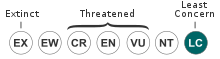
| Conservation status | |
| | |
Scientific classification  | |
| Kingdom: | Animalia |
| Phylum: | Chordata |
| Class: | Aves |
| Order: | Psittaciformes |
| Family: | Psittaculidae |
| Genus: | Melopsittacus Gould, 1840 |
| Species: | M. undulatus |
| Binomial name | |
| Melopsittacus undulatus (Shaw, 1805) | |
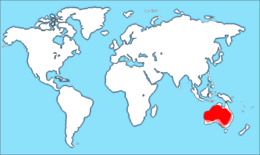 | |
| The budgerigar's natural habitat is in night red; its introduced range is in light red | |
The budgerigar ( buhj-uh-ree-gar;[iii] Melopsittacus undulatus), also known as the mutual parakeet or shell parakeet, is a minor, long-tailed, seed-eating parrot usually nicknamed the budgie ( buhj-ee),[3] [iv] or in American English, the parakeet. Budgies are the merely species in the genus Melopsittacus. Naturally, the species is green and yellow with black, scalloped markings on the nape, back, and wings.[5] Budgies are bred in captivity with colouring of dejection, whites, yellows, greys, and even with pocket-sized crests.[5] [6] Juveniles and chicks are monomorphic, while adults are told apart by their cere colouring, and their behaviour.
The origin of the budgerigar's name is unclear. First recorded in 1805, budgerigars are popular pets around the world due to their small-scale size, low price, and ability to mimic human voice communication. They are probable the third most pop pet in the world, after the domesticated dog and cat.[seven] Budgies are nomadic flock parakeets that accept been bred in captivity since the 19th century. In both captivity and the wild, budgerigars breed opportunistically and in pairs.
It is found wild throughout the drier parts of Commonwealth of australia, where information technology has survived harsh inland weather for over five million years. Its success can be attributed to a nomadic lifestyle and its power to breed while on the motility.[8] The budgerigar is closely related to lories and the fig parrots.[ix] [10] [11] [12]
Taxonomy and etymology [edit]
Budgerigar fossils can exist dated dorsum 50,000–70,000 years. Several possible origins for its name have been proposed. Offset, it may be a mispronunciation or amending of the Gamilaraay word gidjirrigaa (Ancient pronunciation: [ɡ̊iɟiriɡaː])[13] [14] or gijirragaa from the Yuwaalaraay.[15] 2nd is a modification budgery or boojery (Australian English slang for "good") and gar ("cockatoo").[16] Alternative spellings include budgerygah and betcherrygah,[17] the latter used by indigenous people of the Liverpool Plains in New South Wales.[18] While many references mention "good" equally role of the meaning, and a few specify "good bird", it is quite possible that reports past those local to the region are more accurate in specifying the direct translation every bit "skilful nutrient".[nineteen] However, reports that this could besides translate as "tasty treat", implying they were eaten by the Aboriginals, are probable to exist apocryphal. The name likely derived from the species' migratory nature. With seasonal changes that left the plains barren, the budgerigar would move towards residue water that notwithstanding produced the seeds they sought. Past following the birds, the Aboriginals could locate h2o and also other game or food plants – thus, leading to "good nutrient".[ commendation needed ]
| Evolutionary history |
| Phylogenetic chart[9] [x] [11] [12] |
The budgerigar was first described by George Shaw in 1805, and given its current binomial name by John Gould in 1840. The genus proper noun Melopsittacus, from Ancient Greek, means "melodious parrot".[20] The species proper noun undulatus is Latin for "undulated" or "wave-patterned".[21]
Alternative names for the budgerigar include the shell parrot, the warbling grass parakeet, the canary parrot, the zebra parrot, the flight bird, the scallop parrot. Although more than applicable to members of the genus Agapornis, the name lovebird has been practical to them from their habit of common preening.[17] The budgerigar was thought to be the link between the genera Neophema and Pezoporus based on the barred plumage.[22] Notwithstanding, recent phylogenetic studies using DNA sequences place the budgerigar very close to the lories (tribe Loriini) and the fig parrots (tribe Cyclopsittini).[ix] [10] [xi] [12]
Description [edit]

Anatomy of a male budgerigar
Wild budgerigars average 18 cm (seven in) long,[6] counterbalance 30–40 grams (ane.one–1.four oz), xxx cm (12 in) in wingspan, and display a low-cal green body colour (belly and rumps), while their mantles (dorsum and fly coverts) display pitch-black drape markings (blackish in fledglings and immatures) edged in clear yellowish undulations. The brow and face is yellow in adults. Prior to their developed plume, immature individuals have blackish stripes down to the cere (nose) in young individuals until around iii–4 months of age. They brandish modest, irised blueish-violet cheek patches and a series of three black spots across each side of their throats (chosen throat patches). The two outermost throat spots are situated at the base of each cheek patch. The tail is cobalt (dark-blue); and outside tail feathers display central yellow flashes. Their wings take dark-green-black flying feathers and blackness coverts with yellow fringes along with central yellow flashes, which just become visible in flying or when the wings are outstretched. Bills are olive grey and legs blueish-grey, with zygodactyl toes.[22]
In their natural Australian habitat, Budgerigars are noticeably smaller than those in captivity.[23] This particular parrot species has been bred in many other colours and shades in captivity (eastward.g. bluish, grey, grey-green, pieds, violet, white, yellow-blue). Pet store individuals will commonly be blueish, light-green, or yellow. Similar most parrot species, budgerigar plume fluoresces nether ultraviolet light – a phenomenon possibly related to courtship and mate selection.[24] [25]
The upper half of their beaks is taller than the bottom half, covering the bottom when closed. The beak does non beetle much, due to the thick, fluffy feathers surrounding information technology, giving the appearance of a downwards-pointing neb that lies flat confronting the face. The upper half acts as a long, shine embrace, while the bottom half is but about a half-sized cup-piece. These beaks allow the birds to eat plants, fruits, and vegetables.[ citation needed ]
The color of the cere (the area containing the nostrils) differs between the sexes, beingness majestic blue in males, pale brown to white (nonbreeding) or brownish (breeding) in females, and pink in immatures of both sexes (usually of a more even purplish-pinkish colour in young males).[5] Some female person budgerigars develop brown cere simply during breeding time, which subsequently returns to the normal colour.[v] Young females can oft be identified past a subtle, chalky whiteness that starts around the nostrils. Males that are either Albino, Lutino, Nighttime-eyed Articulate or Recessive Pied (Danishpied or harlequin) e'er retain the immature purplish-pinkish cere colour their entire lives.[22] [26]

Wild budgerigars in flying at Mountain Hope, New S Wales, Australia
Behaviours and caput shape also assist indicate sexual practice. Veterinarians can determine the sex of a bird by invasive examination or samples of claret, feather, or eggshell.[ citation needed ]
Mature males usually have a cere of calorie-free to dark blue, just in some particular colour mutations it can be purplish to pink – including Dark-eyed Clears, Danish Pieds (Recessive Pieds) and Inos, which usually display much rounder heads. The behaviour of males can distinguish them from females. Males are typically cheerful, extroverted, highly flirtatious, peacefully social, and very vocal.[ citation needed ]
Female person ceres are pinkish while immature. Every bit they age, they motility from existence beigish or whitish outside breeding condition into brown (ofttimes with a 'crusty' texture) in breeding condition and commonly display flattened backs of heads (right above the nape). Females are more dominant and less socially tolerant.[27] This behavior is more pronounced around other females than with males.[23]
Budgerigars take tetrachromatic colour vision, although all four classes of cone cells will non operate simultaneously unless under sunlight or a UV lamp.[28] The ultraviolet spectrum brightens their feathers to attract mates. The pharynx spots in budgerigars reverberate UV and can be used to distinguish individual birds.[25] While ultraviolet low-cal is essential to the skilful health of caged and pet birds, inadequate darkness or rest results in over-stimulation.[29]
Ecology [edit]

Distribution map of budgerigar in Australia
Distribution area
 Frequent occurrence
 Occasional occurrence
| Climate region key |
|---|
| Equatorial Tropical Subtropical Grassland Desert Temperate |
Budgerigars are nomadic and flocks movement on from sites as environmental weather change.[vii] [30] [6] Budgerigars are found in open habitats, primarily in scrublands, open woodlands, and grasslands of Australia.[seven] The birds are normally constitute in pocket-size flocks, but tin course very big flocks under favourable conditions.[7] The nomadic movement of the flocks is tied to the availability of nutrient and h2o.[22] Budgerigars take ii singled-out flight speeds which they are capable of switching between depending on the circumstance.[31] Drought tin can drive flocks into more wooded habitat or littoral areas. They feed on the seeds of spinifex and grass, and sometimes ripening wheat.[22] [32] [5] [6]
Outside of Australia, the merely long-term institution of naturalised feral budgerigars is a large population about Petrograd, Florida.[22] Increased competition for nesting sites from European starlings and house sparrows is thought to be a primary crusade of the Florida population failing from the 1980s.[30] The more than consistent, yr-round conditions in Florida significantly reduced their nomadic behaviour.[33]
The species has been introduced to various locations in Puerto Rico and the United States.[34]
Budgerigars feed primarily on grass seeds.[xxx] [five] The species also opportunistically depredates growing cereal crops and backyard grass seeds.[35] Due to the low water content of the seeds they rely on the availability of freshwater.[5]
Behaviour [edit]


4 domesticated budgerigars eating corn
Breeding [edit]
Breeding in the wild generally takes place between June and September in northern Australia and betwixt August and January in the south, although budgerigars are opportunistic breeders and respond to rains when grass seeds become most arable.[vi] [5] [22] They bear witness signs of affection to their flockmates by preening or feeding one another. Budgerigars feed 1 some other by eating the seeds themselves, and then regurgitating it into their flockmate's mouth. Populations in some areas accept increased equally a result of increased h2o availability at farms. Nests are made in holes in trees, fence posts or logs lying on the footing; the four to half dozen eggs are incubated for xviii–21 days, with the immature fledging well-nigh xxx days afterwards hatching.[22] [32] [6] [vii]
In the wild, almost all parrot species require a hollow tree or a hollow log as a nest site.[5] Because of this natural behaviour, budgerigars most easily breed in captivity when provided with a reasonable-sized nest box.[ citation needed ]
The eggs are typically i to two centimetres long and are pearl white without whatsoever colouration if fertile. Female budgerigars can lay eggs without a male partner, but these unfertilised eggs volition not hatch. Females normally have a whitish tan cere; however, when the female is laying eggs, her cere turns a crusty brownish colour. Certain female budgies may always go on a whitish tan cere or e'er keep a crusty brownish cere regardless of breeding condition. A female person budgerigar volition lay her eggs on alternating days.[36] Subsequently the first i, at that place is usually a two-day gap until the adjacent. She will usually lay between iv and eight eggs, which she will incubate (ordinarily starting later on laying her second or third) for about 21 days each.[36] Females only leave their nests for very quick defecations, stretches and quick meals once they have begun incubating and are past and then nigh exclusively fed by their mate (usually at the nest's entrance). Females will non allow a male to enter the nest, unless he forces his way inside.[36] Clutch size ranges from half dozen to 8 chicks.[half dozen] Depending on the clutch size and the beginning of incubation, the age divergence between the first and last hatchling can be anywhere from ix to 16 days. At times, the parents may brainstorm eating their own eggs due to feeling insecure in the nest box.[ commendation needed ]
At that place is evidence of same-sex sexual behaviour amongst male budgerigars.[24] It is originally hypothesised that they did this every bit a grade of "courtship practise" so they were better breeding partners for females, however an changed relationship between participation in same-sexual activity behaviour and pairing success.[24]
Chick wellness [edit]

The chicks and eggs of budgerigar in nest box
Breeding difficulties arise for various reasons. Some chicks may dice from diseases and attacks from adults. Other budgerigars (virtually ever females) may fight over the nest box, attacking each other or a brood. Another trouble may be the birds' beaks being under-lapped, where the lower mandible is in a higher place the upper mandible.[ citation needed ]
Nearly health problems and physical abnormalities in budgerigars are genetic. Intendance should be taken that birds used for breeding are active, salubrious and unrelated. Budgerigars that are related or have fatty tumours or other potential genetic wellness problems should not exist allowed to breed. Parasites (lice, mites, worms) and pathogens (bacteria, fungi and viruses), are contagious and thus transmitted between individuals through either direct or indirect contact. Nest boxes should be cleaned between uses.[ citation needed ]
Splay leg is a relatively common problem in babe budgerigars and other birds; 1 of the budgerigar'southward legs is aptitude outward, which prevents it from being able to stand properly and compete with the other chicks for food, and can also lead to difficulties in reproducing in adulthood. The condition is caused by young budgerigars slipping repeatedly on the floor of a nest box. It is hands avoided by placing a small quantity of a safe bedding or forest shavings in the bottom of the nest box. Alternatively, several pieces of paper may be placed in the box for the female to chew into bedding.[ citation needed ]
Development [edit]

A 3-week-old chick beginning to develop feathers and adult coloration.
Eggs take about 18–20 days earlier they start hatching.[ citation needed ] The hatchlings are altricial – blind, naked, unable to lift their caput and totally helpless,[5] [half dozen] and their mother feeds them and keeps them warm constantly. Around x days of age, the chicks' optics will open up, and they volition start to develop feather down. The appearance of down occurs at the historic period for closed banding of the chicks. Budgerigars' closed ring rings must be neither larger nor smaller than four–4.two mm (0.sixteen–0.17 in).[ commendation needed ]
They develop feathers around three weeks of age. (1 can often hands note the colour mutation of the private birds at this indicate.) At this stage of the chicks' development, the male person usually has begun to enter the nest to help his female in caring and feeding the chicks. Some budgerigar females, nonetheless, totally forbid the male from entering the nest and thus have the full responsibility of rearing the chicks until they fledge.[ citation needed ]
Depending on the size of the clutch and most particularly in the case of single mothers, it may then be wise to transfer a portion of the hatchlings (or best of the fertile eggs) to some other pair. The foster pair must already be in breeding mode and thus either at the laying or incubating stages, or already rearing hatchlings.[ commendation needed ]
As the chicks develop and grow feathers, they are able to be left on their own for longer periods of time. Past the 5th calendar week, the chicks are strong enough that both parents will exist comfy in staying out of the nest more than. The youngsters will stretch their wings to gain strength before they attempt to fly. They will also aid defend the box from enemies, generally with their loud screeching. Young budgerigars typically fledge (get out the nest) around their fifth calendar week of age and are usually completely weaned between vi and viii weeks old. All the same, the age for fledging, likewise as weaning, tin vary slightly depending on the age and the number of surviving chicks. More often than not speaking, the oldest chick is the first to be weaned. Although it is logically the last one to be weaned, the youngest chick is frequently weaned at a younger age than its older sibling(s). This can be a result of mimicking the actions of older siblings. Alone surviving chicks are often weaned at the youngest possible age as a result of having their parents' full attention and care.[ citation needed ]
Paw-reared budgies may have slightly longer to wean than parent-raised chicks. Paw feeding is not routinely done with budgerigars, due to their small size and because young parent raised birds tin can exist readily tamed.[ citation needed ]
Relationship with humans [edit]
Aviculture [edit]
The budgerigar has been bred in captivity since the 1850s. Breeders have worked to produce a variety of color, pattern and feather mutations, including albino, blue, cinnamon-ino (lacewinged), clearwinged, crested, dark, greywinged, opaline, pieds, spangled, dilute (suffused) and violet.[five]
"English budgerigars", more correctly called "show" or "exhibition budgerigars", are nigh twice every bit large every bit their wild counterparts and take puffier caput feathers, giving them a boldly exaggerated look. The eyes and beak can be nigh totally obscured by these fluffy head feathers. English language budgerigars are typically more than expensive than wild-blazon birds, and have a shorter life bridge of virtually seven to nine years. Breeders of English budgerigars show their birds at animal shows. Well-nigh convict budgerigars in the pet trade are more similar in size and trunk conformation to wild budgerigars.[ citation needed ]
Budgerigars are social animals and require stimulation in the shape of toys and interaction with humans or with other budgerigars. Budgerigars, and especially females, will chew material such as forest. When a budgerigar feels threatened, it will try to perch as high every bit possible and to bring its feathers close against its trunk in club to announced thinner.[ citation needed ]

Exhibition style "budgie" (left), equally compared to pet-type budgerigars
Tame budgerigars can be taught to speak, whistle and play with humans. Both males and females sing and can learn to mimic sounds and words and do unproblematic tricks, merely singing and mimicry are more pronounced and better perfected in males. Females rarely larn to mimic more than than a dozen words. Males can easily acquire vocabularies ranging from a few dozen to a hundred words. Pet males, especially those kept lone, are generally the best speakers.[37]
Budgerigars volition chew on annihilation they can discover to keep their beaks trimmed. Mineral blocks (ideally enriched with iodine), cuttlebone and soft wooden pieces are suitable for this activity. Cuttlebones also supply calcium, essential for the proper forming of eggs and os solidity. In captivity, budgerigars live an average of five to eight years, simply life spans of xv–20 years have been reported.[38] The life bridge depends on brood, lineage, and health, being highly influenced past exercise and diet. Budgerigars take been known to cause "bird fancier'south lung" in sensitive people, a type of hypersensitivity pneumonitis.[39] Apart from a handful of illnesses, diseases of the species are not transmittable to humans.[40]
Colour mutations [edit]

Adult females (top) display biscuit to white to stake blue ceres, while developed males (bottom) typically have regal blue ceres or purplish-pink in albinistic and recessive pied varieties.
All convict budgerigars are divided into two basic series of colours; namely, white-based (blue, grey and white) and xanthous-based (green, greyness-light-green and yellow).[5] Before long, at least 32 main mutations (including violet) occur, enabling hundreds of possible secondary mutations (stable combined main mutations) and colour varieties (unstable combined mutations).[v]
Mimicry [edit]
Male specimens of budgerigars can be skilled at mimicking homo speech.
Puck, a male budgerigar owned past American Camille Hashemite kingdom of jordan, holds the world tape for the largest vocabulary of any bird, at 1,728 words. Puck died in 1994, with the record start appearing in the 1995 edition of Guinness World Records.[41] [42]
In 2001, recordings of a budgerigar called Victor got some attention from the media. Victor's owner, Ryan B. Reynolds of Canada, stated Victor was able to appoint in contextual chat and predict the hereafter.[43] [44] Although some believe the creature was able to predict his own death as was claimed,[45] further report on the subject field is difficult without the bird. Equally of 2001[update], the recordings all the same remain to be verified by scientific analysis.[46] [ better source needed ] Critics argue Victor'south voice communication in the recordings is not coherent enough to exist determined every bit spoken in context.[47]
The budgerigar "Disco" became Net famous in 2013.[48] Every bit of 2021[update], Disco had been viewed over 22,481,975 times on his YouTube channel.[49] Some of Disco's near repeated phrases included, "I am not a cheat" and "Nobody puts babe bird in a corner!".[50] Disco died in 2017.[ citation needed ]
In popular culture [edit]
Modest bathing suits for men, commonly referred to equally togs or "Speedos", are informally called "budgie smugglers" in Australia. The phrase is humorously based on the appearance of the tight-fitting cloth around the male's genitals looking like a small budgie. The phrase was officially added to the Oxford English language Dictionary in 2016.[51]
See besides [edit]
- Budgerigar colour genetics
- Sparkie (budgerigar)
- Talking bird
- Whipper (budgerigar)
References [edit]
- ^ Boles, Walter E. (1998). "A budgerigar Melopsittacus undulatus from the Pliocene of Riversleigh, Due north-western Queensland". Emu. 98 (i): 32–35. doi:10.1071/MU98004.
- ^ BirdLife International (2018). "Melopsittacus undulatus". IUCN Red List of Threatened Species. 2018. doi:ten.2305/IUCN.UK.2018-2.RLTS.T22685223A132056957.en . Retrieved 10 September 2021.
- ^ a b "budgerigar". Dictionary.com Unabridged . Retrieved 10 September 2021.
- ^ "budgie". Dictionary.com Entire . Retrieved 10 September 2021.
- ^ a b c d eastward f g h i j thousand l m "Budgerigar". Birdlife Australia. Archived from the original on three June 2020. Retrieved 9 September 2021.
- ^ a b c d due east f g h "Budgerigar". The Australian Museum. x December 2020. Archived from the original on 24 July 2020. Retrieved 9 September 2021.
- ^ a b c d e Perrins, Christopher, ed. (2003). "Parrots, Lories, and Cockatoos". The New Encyclopedia of Birds. Oxford Academy Press. ISBN9780198525066 . Retrieved x September 2021.
- ^ "Dr. Marshall's Philosophy on Breeding Exhibition Budgerigars". Bird Health. 2004. Archived from the original on 11 August 2004. Retrieved 4 November 2013.
- ^ a b c Wright, TF; Schirtzinger EE; Matsumoto T; Eberhard JR; Graves GR; Sanchez JJ; Capelli S; Mueller H; Scharpegge J; Chambers GK; Fleischer RC (2008). "A Multilocus Molecular Phylogeny of the Parrots (Psittaciformes): Back up for a Gondwanan Origin during the Cretaceous". Molecular Biological science and Evolution. 25 (10): 2141–2156. doi:10.1093/molbev/msn160. PMC2727385. PMID 18653733.
- ^ a b c Tokita, M; Kiyoshi T; Armstrong KN (2007). "Evolution of craniofacial novelty in parrots through developmental modularity and heterochrony". Evolution & Development. 9 (6): 590–601. doi:10.1111/j.1525-142X.2007.00199.x. PMID 17976055. S2CID 46659963. Archived from the original on five October 2012.
- ^ a b c de Kloet, RS; de Kloet SR (2005). "The evolution of the spindlin factor in birds: Sequence assay of an intron of the spindlin W and Z cistron reveals four major divisions of the Psittaciformes". Molecular Phylogenetics and Evolution. 36 (three): 706–721. doi:10.1016/j.ympev.2005.03.013. PMID 16099384.
- ^ a b c Schweizer, M.; Seehausen O; Güntert Chiliad; Hertwig ST (2009). "The evolutionary diversification of parrots supports a taxon pulse model with multiple trans-oceanic dispersal events and local radiations". Molecular Phylogenetics and Evolution. 54 (iii): 984–94. doi:10.1016/j.ympev.2009.08.021. PMID 19699808.
- ^ "gidjirrigaa". Gamilaraay Dictionary. Archived from the original on 4 Jan 1997.
- ^ "budgerigar". Macquarie Dictionary. Macquarie Dictionary Publishers. Retrieved ten September 2021.
- ^ "budgerigar". Merriam-Webster.com Dictionary. Merriam-Webster. Retrieved x September 2021.
- ^ "budgerigar (n.)". Online Etymology Dictionary. Douglas Harper. Retrieved ten September 2021.
- ^ a b Lendon, Alan H. (1973). Australian Parrots in Field and Aviary (second ed.). Sydney: Angus and Robertson. pp. 302–07. ISBN0-207-12424-8.
- ^ Gould, John (2009). "Indigenous Bird Names of the Hunter Region of New South Wales". Australian Museum. Sydney, New South Wales: Australian Museum. Archived from the original on 17 October 2009. Retrieved 22 February 2010.
- ^ "HAMILTON & DISTRICT BUDGERIGAR & Muzzle BIRD Guild INC". www3.sympatico.ca . Retrieved 9 September 2021.
- ^ Liddell, Henry George & Robert Scott (1980). A Greek-English Lexicon (Abridged ed.). United Kingdom: Oxford University Press. ISBN0-19-910207-iv.
- ^ Simpson, D.P. (1979). Cassell's Latin Dictionary (5th ed.). London: Cassell Ltd. ISBN0-304-52257-0.
- ^ a b c d eastward f 1000 h Forshaw, Joseph Michael; Cooper, William T. (1981) [and 1st edition in 1973]. Parrots of the World. Illustrated by Frank Knight (2d ed.). Princeton University Press. pp. 175–176. ISBN0-87666-959-3.
- ^ a b "Budgerigar.com". Archived from the original on twenty September 2018.
- ^ a b c Abbassi, Puya; Burley, Nancy Tyler (1 July 2012). "Dainty guys cease last: same-sexual activity sexual behavior and pairing success in male budgerigars". Behavioral Environmental. 23 (four): 775–782. doi:x.1093/beheco/ars030. ISSN 1045-2249.
- ^ a b S M Pearn; A T Bennett & I C Cuthill (2001). "Ultraviolet vision, fluorescence and mate selection in a parrot, the budgerigar Melopsittacus undulatus". Proceedings: Biological Sciences. 268 (1482): 2273–ix. doi:10.1098/rspb.2001.1813. PMC1088876. PMID 11674876.
- ^ "Birds Online — How to tell the sex of a budgie". Retrieved 25 Apr 2006.
- ^ "Talk Budgies FAQ". Retrieved four November 2013.
- ^ Color Vision of the Budgerigar (Melopsittacus undulatus): Hue Matches, Tetrachromacy, and Intensity Discrimination.
Timothy H. Goldsmith and Byron G. Butler in Journal of Comparative Physiology A, Vol. 191, No. 10, pages 933–951; October 2005. - ^ Hildegard Niemann (2007). Budgerigars: Everything about Purchase, Intendance, Nutrition, Behavior, and Training . Barron's Educational Serial, 2008. p. 59. ISBN9780764138973.
- ^ a b c Pranty 2001
- ^ Ingo Schiffner and Mandyam Srinivasan (2016) Budgerigar flight in a varying environment: flight at distinct speeds?, https://doi.org/10.1098/rsbl.2016.0221
- ^ a b "The Wild Budgerigar". Archived from the original (commodity) on half-dozen March 2009. Retrieved 25 Apr 2006.
- ^ Shapiro 1979
- ^ "IUCN Cherry Listing of Threatened Species: Melopsittacus undulatus". IUCN Cerise Listing of Threatened Species. 9 Baronial 2018. 9 August 2018.
- ^ Stevenson & Anderson 1994
- ^ a b c "Talk Budgies — Breeding". Retrieved 4 November 2013.
- ^ Moustaki, Nikki (2007). Parakeets for dummies. Hoboken, Northward.J.: Wiley. ISBN9781118068281. OCLC 785572631.
- ^ "Birds Online — Life span of a budgie". Retrieved 26 December 2005.
- ^ Hendrick, D. J.; Faux, J. A.; Marshall, R (July 1978). "Budgerigar-fancier'southward lung: the commonest multifariousness of allergic alveolitis in United kingdom of great britain and northern ireland". Br Med J. 2 (6130): 81–4. doi:10.1136/bmj.two.6130.81. PMC1605890. PMID 566603.
- ^ Hildegard Niemann (2007). Budgerigars: Everything most Purchase, Care, Nutrition, Beliefs, and Grooming . Barron's Educational Series, 2008. p. 62. ISBN9780764138973.
- ^ Claire Folkard, ed. (2003). Guinness World Records 2004. Guinness Globe Records Express. p. 54. ISBN0-85112-180-two.
- ^ "The Bird with the Largest Vocabulary in the Globe". Archived from the original on 28 September 2007. Retrieved iv Nov 2013.
- ^ "Budgie Enquiry". Archived from the original on 30 November 2003. Retrieved 4 November 2013.
- ^ "Parakeets". Archived from the original on 10 November 2007. Retrieved four November 2013.
- ^ "Talking Budgie Predicts His Own Expiry". Retrieved iv November 2013.
- ^ "Parakeets — info and games". Retrieved 4 November 2013.
- ^ "Victor the Talking Budgie". Retrieved 4 November 2013.
- ^ "WATCH: Disco, The Parakeet, Takes On 'Monty Python'". NPR . Retrieved 4 November 2013.
- ^ "Disco the Parakeet". YouTube . Retrieved 4 November 2013.
- ^ "Disco the parakeet will blow your mind with his vintage banter". Archived from the original on 22 Oct 2013. Retrieved 4 November 2013.
- ^ "'Budgie smugglers' officially added to Oxford English language Dictionary". ABC News. eight July 2016.
Bibliography [edit]
- Pranty, B. 2001. The Budgerigar in Florida: Rise and fall of an exotic psittacid. North American Birds 55: 389–397.
- Forshaw, Joseph M. & Cooper, William T. (1978): Parrots of the World (2nd ed). Landsdowne Editions, Melbourne Australia ISBN 0-7018-0690-7
- Neckband, Northward. J. (1997). Budgerigar (Melopsittacus undulatus). Pg. 384 in: del Hoyo, J., Elliott, A. & Sargatal, J. eds. (1997).
Handbook of the Birds of the World. Vol. iv. Sandgrouse to Cuckoos. Lynx Edicions, Barcelona. ISBN 84-87334-22-9
Further reading [edit]
 The lexicon definition of budgerigar at Wiktionary
- World Parrot Trust Parrot Encyclopedia — Species Profiles
- A True Administrator: the Budgerigar Referenced article on budgerigars
- Budgerigar genome in Ensembl
- View the melUnd1 genome associates in the UCSC Genome Browser.
Source: https://en.wikipedia.org/wiki/Budgerigar

Publicar un comentario for "Should Baby Chicks Be Left in the Dark"